

Polish food has two faces. Traditional, old recipes, with a lot of French influences, from before the communist era, are a remembrance of the days of aristocracy. Many of them are forgotten, although more and more people search for old “bourgeois” recipes. On the other hand you have simple, but tasty comfort food of hard-working farmers. One example of this type of food is żurek.
Żurek, in some regions known as “żur”, is a soup made with sour rye starter. The name of the soup probably has its origins in German language and means “sour”.
The starter – called “zakwas” is made out of water and flour, which acquire an acid taste during the natural process of fermentation. According to old cook books, this soup was one of the basic dishes in peasant’s cooking. Now, it is one of the most popular soups in my country, regardless of the profession and of the social status, thanks to historical changes.
In daily cooking, aside from the starter which is a sine qua non condition of żurek, meat, sausages or smoked bacon usually are used. The vegetarian version, which is often served as a traditional soup for Easter, uses mushroom or vegetable broth.
The key for a successful and delicious żurek is a homemade or a good artisan sour rye starter.
The latter you will rather not get abroad, that’s why I share here with you the traditional Polish recipe for the starter, which I already made many times.
Sour rye starter (zakwas)

Makes 1 liter
Ingredients
6-7 tablespoons whole grain rye flour
1 liter warm (about 30°) mineral water, previously boiled
1 bay leaf
2 grains all spice
2 cloves garlic, thinly chopped
1 jar (1 liter capacity), preferably sterilized
1 piece of fabric to cover the jar and 1 rubber band to hold it
Preparation
Put flour into the jar and pour the mineral water over it.
Add allspice and the bay leaf.
Slowly, mix with a wooden spatula.
Cover the jar with the fabric, attach it with the rubber band and place the jar in a warm place.
Keep for 4 days.
The ideal temperature is between 18 and 22 degrees centigrade.
Mix delicately the liquid twice a day with a clean wooden spatula and then cover again.
If necessary, remove the foam that is forming on the surface of the liquid.
On the third day, add garlic and mix well.
Before pouring the liquid into the broth (see below) strain it and throw away the flour.
This is optional. Some people prefer to add this flour to the broth, to make the soup thicker.
Good quality rye flour is essential for delicious sour rye starter. The best is coarse rye flour, available practically only in good food markets in Poland. It is so coarsely milled, than I have doubts if one can call it “flour”. Often it is sold by farmers, who make it on their own. Usually I buy the “żurek” flour in Poland. I did not find this product in France.
In Poland, in stores selling organic food and sometimes, upscale supermarkets, you can buy rye flour called “żurek flour”. It is finely milled in comparison to the one I mentioned above, but you can use it to make a starter, as well. The name “żurek” traditionally refers to the soup made with a sour rye starter.
You may also use Rye Organic Flour which is easily found in organic food stores in France.
There are some other soups prepared with various sour starters, for example “white bortsch” which uses a wheat starter or “żur owsiany” which uses a rolled oats starter. Few Polish people are aware of those differences nowadays.
I found out that ready-to-use sour rye starters available in food markets are quite often made from a mixture of rye and wheat flour.
Unfortunately, even in Poland, industrial starters have been replacing those traditional ones, which are much better. Industrial starters are available in every Polish food store. Artisanal ready-to-use sour rye starters are available on most food markets, organic shops and some good epiceries.
In Paris, one can find starters in stores carrying Polish food. However, I found out that this industrial starter usually is of poor quality.
More explanation regarding home preparation of the starter:
The proportion between flour and water is not so strict. Some people will prefer a very thick starter and they simply will use more flour than indicated in my recipe. Some of them will use less flour. Everything depends on one’s preferences. My recipe is in between – the starter is not too thin neither too thick, but quite strong and tasty. Some add a piece of rye bread crust for the taste. As it is difficult to buy “real” rye bread made from artisanal sour dough starter, without softeners, I avoid adding bread, as I do not want to spoil my starter.
I always use boiled mineral water for my starter as it is known that tap water is not good in Kraków. I prefer to use sterilized jars; however people usually do not pay attention to that. Then some of them complain than the starter is stinky and killed by bad microbes.
Very often the first homemade starter may need a longer fermentation, about one or two days more than indicated in the recipe and, its taste may be less intense. That is why some advice to throw most of first starter away, keeping only a small part of the fermented flour in the jar and then to add to it a new portion of fresh flour and water as indicated in the recipe.
The second starter will ferment quicker and should be ready within two days. Much of it depends on the quality of the flour, as I mentioned above. The temperature is important as well. It may not be too cold and nor too warm. That is why your jar must be stored in a place where the temperature is between18 and 22 degrees centigrade.
It is not necessary to add the allspice, bay leaves and garlic to your starter, as you can always add them straight into the broth. However, adding them to the starter will simply taste better.
Once the starter is ready (you can recognize this by its intense off-white color as well as by its acid smell and taste), it may be used right away or stored, covered, in the refrigerator for up to two weeks.
I recommend using only the liquid part of the starter for the soup. Some people, like my grandma, add the liquid and the flour to the soup. I do not like this because the soup is too thick and it resembles a puree. Further, it is more difficult to digest and the taste is “heavier”.
Żurek
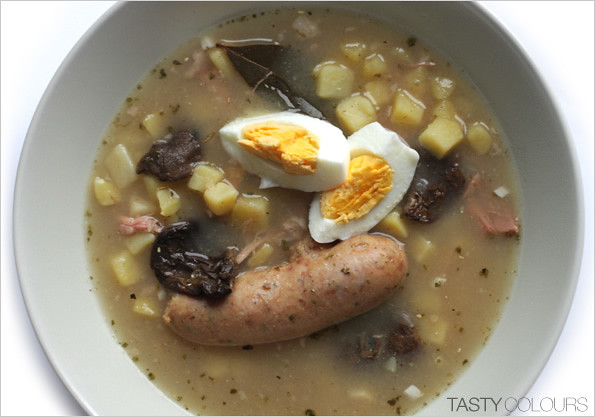
Serves 4
Ingredients
1 liter sour rye starter
300 g veal ribs
4 caps dried ceps
2 white pork sausages, raw (300 g total) – may be replaced by Saucisse de Toulouse
2 carrots, peeled and washed
½ celery root, peeled and washed
1 shallot, unpeeled, washed and cut into halves
2 bay leaves
3 grains all spice
1 teaspoon marjoram
5 to 6 grains black pepper
5 medium potatoes, peeled and washed, cut into small cubes
2 hard boiled eggs, peeled and cut into quarters
100 ml crème fraîche (optional)
Preparation
Place the meat in a saucepan and add 1 liter of boiling water.
Add mushrooms, bay leaves, allspice and pepper.
Cook for 30 minutes, under the cover.
Then, add carrots, celery root and onion.
Cook until the vegetables are completely soft – between 30 and 40 minutes.
Remove vegetable from the saucepan, add potatoes and sausages, and cook for about 10 minutes, until potatoes are cooked.
Strain the starter and only keep the liquid.
Pour the starter into the broth.
Season with marjoram, salt and pepper.
Bring to a boil, cook for another 5 minutes and serve hot with hard boiled eggs.
Add the cream (optional).
Should you ever have a chance to try this soup in a Polish restaurant, please remember that a good Żurek should be quite acid. Unfortunately, in cheaper places soups are prepared from industrial starters or the proportion between the starter and the stock is not right, thus the soup loses its particular sour taste.
My favorite version of the soup is with white sausage (called biała kiełbasa). It is a sausage usually made of a mixture of pork and beef meat. It usually is sold raw and needs to be cooked or grilled before eating.
White sausage (which is difficult to get in France and sometimes found in shops carrying Polish food) may be replaced by a sausage from Toulouse. You can also use some Polish charcuterie, such as Polish smoked sausages, bacon, ham which are available in shops carrying Polish food in France. It is, however, not obligatory. You can eat your Żurek without any sausage or meat just as a vegetarian version of the soup with eggs and potatoes. Then, instead of preparing a meat broth simply use vegetable or mushroom bullion.
Some people also add whey (or milk plasma), that is, the liquid remaining after milk has been curdled and strained.
Old cookbooks indicate that very old fashioned versions of the soup were using curd cheese; however I never found this version of the soup in any restaurant.





0 Comments